





Annual Subscription vs Lifetime WordPress Plugins and Themes: Which Is Better in 2026?
When buying a premium WordPress plugin or theme, one question appears again and again:
Should you pay for an annual subscription, or choose a lifetime license and pay once?
At first, the answer seems obvious. A lifetime deal sounds better because you make one payment instead of receiving another renewal bill every year. But the cheapest option today is not necessarily the cheapest—or safest—option over the lifetime of your website.
Annual licenses often include continuous updates, compatibility improvements, new features, and technical support. Lifetime plans can dramatically reduce your long-term costs, but their exact benefits depend on the developer, product, site limits, update policy, and what the word “lifetime” actually includes.
That distinction matters more than ever because WordPress remains an enormous software ecosystem. As of 2026, W3Techs estimates that WordPress powers around 41% of all websites on the internet and roughly 59% of websites using a known content management system.
The official WordPress Plugin Directory alone contains more than 60,000 plugins, while WordPress.org lists over 14,000 free themes. The ecosystem is still expanding: the WordPress Plugins Team reported reviewing 12,713 plugin submissions during 2025, 40.6% more than in 2024.
With this many options—and an even larger commercial ecosystem outside WordPress.org—understanding licensing costs can save a website owner, freelancer, or agency a significant amount of money.
Annual Subscription vs Lifetime License: The Quick Answer
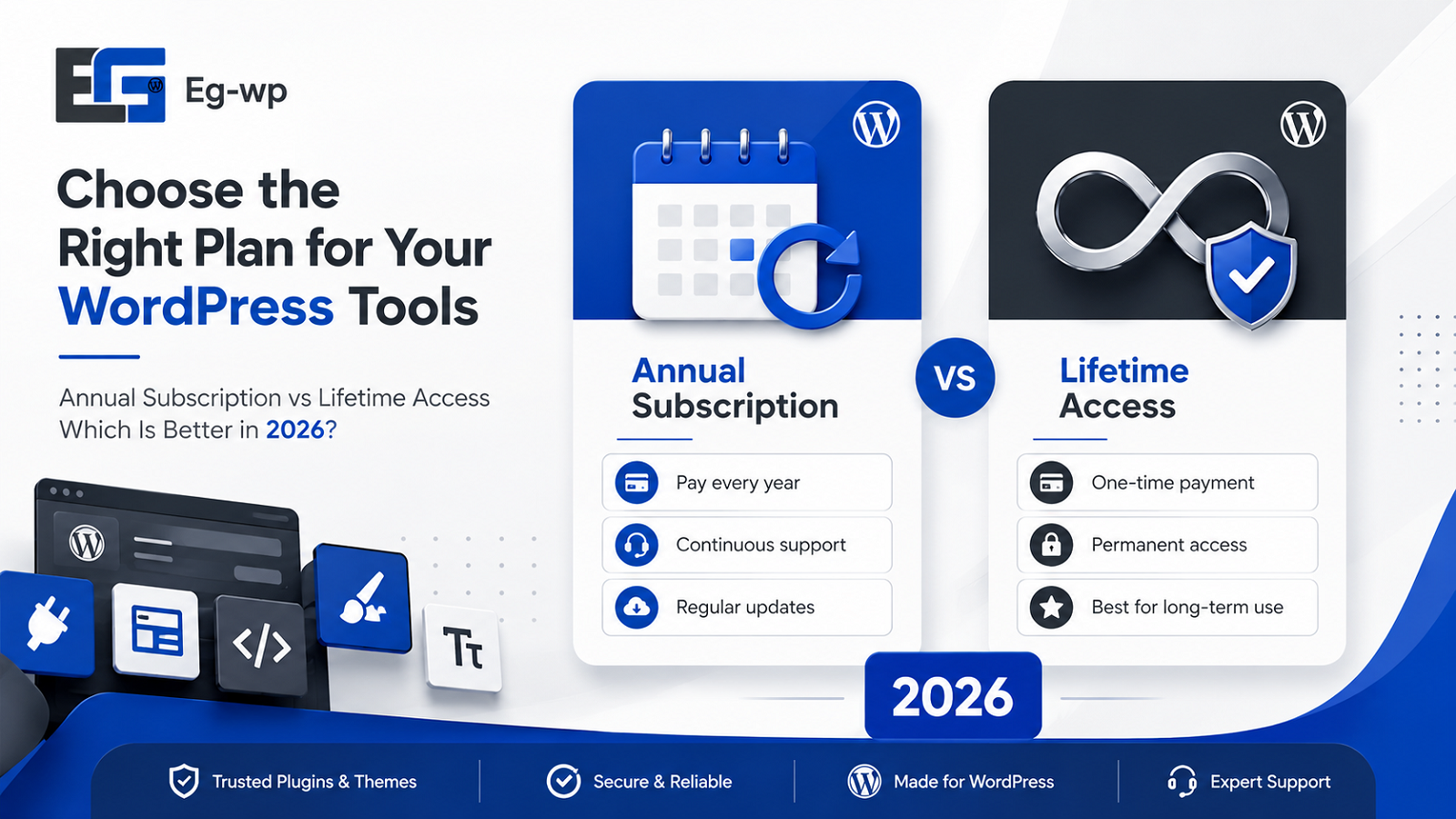
For most WordPress products, the difference can be summarized like this:
| Annual Subscription | Lifetime License |
|---|---|
| Pay every year | Pay once |
| Lower initial cost | Higher initial cost |
| Usually includes updates while active | May include lifetime updates, depending on the product |
| Usually includes active technical support | Support terms vary by developer |
| Easy to stop if you no longer need the product | Best value when used for several years |
| Good for temporary or uncertain projects | Good for established sites and agencies |
| Recurring operating expense | Larger one-time investment |
Neither model is automatically better.
Annual subscriptions usually make more sense when you need flexibility and a low upfront cost. Lifetime licenses become more attractive when you know you will use the plugin or theme for several years.
Real WordPress pricing demonstrates this clearly.
Divi, for example, currently offers its WordPress theme and builder for $89 per year, while its standard lifetime option is $249 as a one-time purchase.
That means that, ignoring discounts or future price changes, three years of Divi annual payments would cost:
$89 × 3 = $267
At that point, the $249 lifetime purchase has already become cheaper.
Astra provides another real-world example. Its Astra Pro + AI plan is currently advertised at $99 for the first year, renewing at $149 per year, while a lifetime option is offered for $279 as a one-time payment.
Not every major WordPress product offers lifetime pricing, however. WP Rocket, for example, currently sells its single-site performance plugin license for $59 per year, including product updates and support for one website.
This is why comparing only the advertised price can be misleading.
What Does an Annual WordPress License Actually Mean?
An annual license normally gives you access to a premium plugin or theme for a 12-month licensing period.
Depending on the developer, that subscription may cover:
- Plugin or theme updates
- New features
- WordPress compatibility updates
- Security fixes
- Premium templates or extensions
- Customer support
- License activation on a specific number of websites
When the year ends, the license usually renews if you want to continue receiving those benefits.
In many cases, cancelling does not necessarily mean that the plugin instantly disappears from your website. The important question is what happens to updates, support, premium services, and license validation after expiration. Those rules vary from product to product and should always be checked before purchasing.
And that leads to the biggest mistake buyers make when comparing annual subscriptions with lifetime WordPress plugins and themes:
They compare the purchase price instead of the total cost of ownership.
In the next section, we will calculate what annual and lifetime WordPress licenses can really cost over 1, 3, 5, and 10 years—and show when paying more upfront can actually save you hundreds or even thousands of dollars.
The Real Cost of Annual vs Lifetime WordPress Licenses
The biggest difference between an annual WordPress subscription and a lifetime license becomes obvious when you stop looking at the first-year price and start calculating the total cost over several years.
A $59 or $99 yearly license may look inexpensive today. But if your website stays online for five or ten years—as many successful business websites do—the accumulated renewal cost can become much larger than the original purchase price.
This is where total cost of ownership matters.
Annual vs Lifetime Cost Over 1, 3, 5 and 10 Years
Consider Divi as a real-world example.
Elegant Themes currently lists the standard Divi Theme & Builder plan at $89 per year. Its lifetime offering provides permanent access to the core Divi product for a one-time payment, with the standard lifetime price shown at $249 in Elegant Themes’ current product materials.
If we compare $89 every year against a $249 lifetime purchase, the difference looks like this:
| Period | Divi Annual at $89/year | Lifetime at $249 | Potential Difference |
|---|---|---|---|
| 1 year | $89 | $249 | Annual saves $160 initially |
| 3 years | $267 | $249 | Lifetime saves $18 |
| 5 years | $445 | $249 | Lifetime saves $196 |
| 10 years | $890 | $249 | Lifetime saves $641 |
The important number is not year one.
It is the break-even point.
At $89 per year, $249 divided by $89 equals approximately 2.8 years. In practical terms, if you expect to continue using Divi into a third year, the lifetime option can begin making more financial sense.
Over ten years, the difference becomes substantial.
Instead of spending $890 on recurring annual payments, the core lifetime purchase remains $249—assuming the pricing and license benefits remain as described by the vendor.
Astra Shows the Same Long-Term Pricing Effect
Astra provides another useful example.
Its current Astra Pro + AI pricing advertises an introductory annual price of $99 for the first year, followed by renewal at $149 per year. A lifetime option is listed at $279 as a one-time payment.
Using those advertised rates:
| Period | Astra Annual* | Lifetime | Potential Difference |
|---|---|---|---|
| 1 year | $99 | $279 | Annual saves $180 initially |
| 3 years | $397 | $279 | Lifetime saves $118 |
| 5 years | $695 | $279 | Lifetime saves $416 |
| 10 years | $1,440 | $279 | Lifetime saves $1,161 |
*Using the advertised $99 first-year price and $149 annual renewal price currently shown by Astra.
Again, the annual option wins when looking only at the first year.
But by the third year, the lifetime option can already become cheaper.
Over ten years, the difference based on today’s advertised rates exceeds $1,000.
This is one reason lifetime WordPress themes and plugins can be particularly attractive to people who expect to maintain the same website stack for many years.
Astra also states that websites using an expired annual plan can remain functional, but customers lose access to updates and support after the annual period ends.
That distinction is extremely important.
Not Every WordPress Plugin Offers Lifetime Pricing
Lifetime licenses are not available for every premium WordPress product.
WP Rocket, for example, currently starts at $59 per year for one website, with product updates and customer support included.
At a constant $59 annual price, the theoretical subscription cost would be:
- 1 year: $59
- 3 years: $177
- 5 years: $295
- 10 years: $590
This does not mean WP Rocket is expensive or poor value. It simply demonstrates how recurring software expenses accumulate.
Premium WordPress websites often use much more than one paid product.
A professional website might require a premium theme, page builder, SEO solution, backup system, security plugin, form builder, performance plugin, WooCommerce extensions, or other specialized tools.
Imagine a site using five premium products averaging only $70 per year each.
That would equal:
5 × $70 = $350 per year
Over five years:
$350 × 5 = $1,750
Over ten years:
$350 × 10 = $3,500
For agencies managing multiple websites, recurring license costs can become even more significant.
Why Lifetime Licenses Can Be Powerful for WordPress Agencies
The economics change dramatically when you build websites professionally.
A blogger might use a theme on one website.
A freelancer might manage ten sites.
A WordPress agency could manage dozens or even hundreds.
When a lifetime license permits use across many or unlimited websites, the effective cost per website can fall dramatically.
Suppose a legitimate lifetime license costs $300 and allows activation across 100 client websites.
The effective software cost would be:
$300 ÷ 100 = $3 per website
If the same software required a recurring $100 annual agency subscription, five years would cost $500.
The actual saving depends entirely on the specific vendor’s site limits, licensing conditions, updates, and support policy, so customers should always check the terms before purchasing.
This is especially important because the word “lifetime” does not have exactly the same meaning for every WordPress company.
For one developer, lifetime may include future updates and support.
For another, it may cover updates but impose separate limitations on premium cloud services.
Some products may offer lifetime access to the plugin itself while charging recurring fees for AI credits, cloud storage, templates, SaaS features, or premium services.
For example, Elegant Themes currently separates lifetime access to core Divi products from some recurring Divi Pro services.
So the correct question is not simply:
“Is this a lifetime license?”
The better questions are:
What exactly is included for life? How many websites can I activate? Are updates included? Is technical support included? Are cloud or AI features separate?
When Annual Subscriptions Are Actually the Better Choice
Despite the long-term savings shown above, lifetime licenses are not always the right purchase.
An annual license can make more sense when:
- You are testing a plugin or theme for the first time.
- The website may only exist for a short period.
- You expect to redesign the site within one or two years.
- You do not know whether the plugin will remain part of your WordPress stack.
- Cash flow matters more than long-term savings.
- The lifetime price is several times higher than the annual price.
- The product depends heavily on recurring cloud infrastructure or external services.
For a new website, paying $60–$100 instead of several hundred dollars upfront may allow you to invest the remaining budget into hosting, content, SEO, design, or advertising.
But once a product becomes an essential part of your website and you know you will continue using it, the calculation changes.
That is when a lifetime activation can become much more interesting.
The Simple Break-Even Formula
You can estimate whether a lifetime WordPress license is worthwhile with a very simple calculation:
Lifetime Price ÷ Annual Price = Break-Even Time
For example:
$249 ÷ $89 = 2.8 years
If you expect to use the product longer than approximately 2.8 years, the lifetime option is likely cheaper based purely on license cost.
But price is only half of the decision.
A WordPress plugin or theme is software—and software needs to remain compatible, updated, secure, and maintained.
That brings us to an even more important question:
Are lifetime WordPress plugins and themes actually safe, and what happens to updates, security patches, support, and compatibility over time?
Updates, Security and Support — The Factors That Matter More Than Price
Saving money is important, but a WordPress plugin or theme should never be judged on price alone.
A $200 lifetime license can be excellent value if the developer continues maintaining the product for years. On the other hand, even a free or extremely cheap plugin can become expensive if it creates compatibility problems, introduces a vulnerability, or forces you to rebuild part of your website.
This is why updates and long-term maintenance should be part of every annual vs lifetime license comparison.
WordPress Plugins and Themes Need Regular Updates
WordPress itself changes continuously.
PHP versions change. Browsers evolve. WooCommerce releases updates. WordPress introduces new APIs and features. Page builders change their internal systems.
A plugin or theme that works perfectly today may eventually require modifications to remain compatible with the rest of your WordPress installation.
WordPress’s own security documentation recommends keeping WordPress Core, installed plugins, and themes up to date and encourages users to choose extensions that are actively maintained.
That means the real value of a premium WordPress license is not simply the ZIP file you download.
A significant part of what you are paying for is continued development.
Security Updates Are Especially Important
The size of the WordPress ecosystem also makes plugin security a serious consideration.
Patchstack’s State of WordPress Security in 2026 report recorded 11,334 new vulnerabilities across the WordPress ecosystem during 2025, representing a 42% increase compared with 2024. Of those vulnerabilities, 1,966 were classified as high severity in Patchstack’s analysis.
The previous year’s data shows where much of the risk exists.
Patchstack reported that 96% of vulnerabilities identified in its 2024 dataset were found in plugins, while approximately 4% were associated with themes. Only seven were found in WordPress Core in that dataset.
This does not mean WordPress plugins are inherently unsafe.
There are tens of thousands of plugins covering almost every imaginable function, so third-party code represents a huge portion of the overall WordPress software ecosystem.
The important lesson is simpler:
If a plugin is important enough to install on your website, it is important enough to keep updated.
Lifetime Should Mean Lifetime Updates — Not Just Lifetime Activation
This is where buyers need to read product terms carefully.
A lifetime license is most valuable when it includes continued access to official updates.
Suppose you purchase lifetime activation for a WordPress plugin today and continue using it for six years.
During those six years there could be:
- New WordPress releases
- New PHP versions
- WooCommerce updates
- Browser changes
- Security patches
- Database changes
- New integrations
- Performance improvements
If your lifetime license includes official updates, you can continue benefiting from those improvements without paying a new annual license fee.
But if “lifetime” simply means the existing version remains activated forever while future updates require another purchase, the value proposition is completely different.
Before buying any lifetime WordPress plugin or theme, check whether the offer explicitly includes:
Lifetime activation, lifetime updates, the allowed number of websites, and any limitations on support or cloud-based services.
These terms should never be assumed.
Updates Are Also About Compatibility
Security is only one reason to update.
Compatibility problems are another.
Imagine that your online store depends on a checkout customization plugin.
A major WooCommerce update arrives.
Your plugin has not been maintained for two years.
Suddenly:
- Checkout fields stop displaying correctly.
- Certain payment options fail.
- PHP warnings appear.
- Your theme conflicts with the plugin.
- Customers cannot complete their purchases.
The cost of fixing that problem could easily exceed what you originally saved by choosing the cheapest license.
For business websites, the correct question therefore isn’t:
“How cheaply can I activate this plugin?”
It is:
“Can I keep this plugin updated and working reliably for as long as I need it?”
What About WordPress Automatic Updates?
WordPress includes built-in tools that can make plugin and theme maintenance easier.
Since WordPress 5.5, administrators have been able to opt individual plugins and themes into automatic updates from the WordPress dashboard.
WordPress also uses automatic background updates for many Core maintenance and security releases, a system originally introduced with WordPress 3.7.
However, automatic updating does not remove the need for a valid update source.
If your premium plugin requires an active license or activation to receive new versions, the update system still depends on having legitimate access to those updates.
That is why an activation sold with continued updates can be far more useful than a one-time installation of an old premium plugin version.
Lifetime License vs Nulled Plugin: They Are Not the Same Thing
This distinction is extremely important for WordPress buyers.
A lifetime activation is not the same as a nulled plugin or theme.
A legitimate lifetime license or activation should provide access to the product under the terms offered by the seller or developer.
A nulled plugin, by contrast, usually refers to a modified premium plugin or theme distributed outside its intended commercial licensing system.
The software may have been altered to bypass license checks or remove restrictions.
That creates several practical problems.
You may not know:
- Who modified the files
- Whether malicious code was added
- Whether the plugin has been changed from the original release
- Whether official updates will work
- Whether future vulnerabilities will be patched
- Whether premium APIs and integrations will continue working
For an e-commerce store, business website, membership website, or client project, those uncertainties can create unnecessary risk.
At Eg-WP, the value proposition should therefore be centered on reliable WordPress plugin and theme activation—not simply obtaining premium files as cheaply as possible.
Buyers should care about activation, update access, compatibility, and clear licensing conditions.
Does Annual Support Make the Subscription Worth It?
Support can be one of the strongest arguments in favor of an annual subscription.
Premium WordPress support may help you troubleshoot:
- Installation problems
- Theme conflicts
- Plugin configuration
- WooCommerce compatibility
- Errors after an update
- Advanced features
- API connections
- Licensing problems
For beginners, access to direct developer support can be extremely valuable.
For an experienced developer or agency, however, support may be used very rarely.
This changes the economics.
Imagine paying $100 every year primarily to retain technical support but contacting the developer only once in five years.
If an equivalent lifetime option provides the updates you require, the annual subscription may offer less financial value.
On the other hand, if a plugin is mission-critical to a high-revenue WooCommerce store, paying annually for immediate access to expert support may be a very reasonable business expense.
Who Benefits Most From Annual WordPress Licenses?
Annual subscriptions tend to fit:
- New WordPress users who expect to need technical support
- Websites still experimenting with their technology stack
- Short-term websites and projects
- Businesses that prefer predictable yearly software expenses
- Products that rely heavily on SaaS or cloud infrastructure
- Users who regularly switch themes and plugins
Who Benefits Most From Lifetime WordPress Licenses?
Lifetime licenses tend to be more attractive for:
- Long-term business websites
- Bloggers planning to operate for many years
- Freelancers
- WordPress developers
- Web design agencies
- Owners of multiple websites
- WooCommerce store operators with a stable technology stack
- Users who want to reduce recurring WordPress expenses
The larger your portfolio of websites becomes, the more important this calculation can become.
A single $80 renewal is easy to ignore.
But ten products renewing for $80 each equal $800 every year.
Over five years, assuming the prices remain unchanged:
$800 × 5 = $4,000
At that scale, strategically choosing lifetime licenses and lower-cost activation options can make a meaningful difference to operating expenses.
However, cost should still come after one requirement:
Make sure you can keep the software updated.
A WordPress website is not a static product. It is an evolving software environment.
That brings us to the final question.
So Which Should You Buy: Annual or Lifetime?
There is no universal winner.
Annual subscriptions provide a lower entry cost, flexibility, and often ongoing developer support.
Lifetime options require more money upfront but can become dramatically cheaper when you keep using the same product for several years.
The best choice depends on:
how long you will use the product, how many websites you manage, whether updates are included, how much you value direct support, and how much recurring cost you want to carry every year.
Annual vs Lifetime WordPress Plugins — The Final Verdict
So, should you choose an annual subscription or a lifetime WordPress plugin/theme activation?
For most buyers, the answer comes down to one factor:
How long do you realistically expect to use the product?
If you are testing a new plugin, building a temporary website, or are not sure whether a theme will remain part of your setup, an annual subscription usually makes sense. You pay less upfront and can move to another product later without having invested heavily.
However, if you have already found a plugin or theme that you expect to use for several years, a lifetime option can offer substantially better long-term value.
The earlier examples demonstrate why.
A product costing $89 every year costs $445 over five years if its price never changes. A $249 lifetime alternative reaches its break-even point in less than three years and avoids another renewal bill after that.
Multiply that effect across several premium plugins, themes, websites, or client projects, and recurring WordPress software costs can become significant.
A Simple Rule for Choosing
Use this formula before buying:
Lifetime price ÷ annual renewal price = approximate break-even point
If the lifetime option costs $250 and the annual license costs $100:
$250 ÷ $100 = 2.5 years
If you expect to use the product for four or five years, lifetime access may be the stronger financial choice.
If you expect to replace it next year, paying $250 upfront probably makes little sense.
But price should never be the only consideration.
WordPress specifically recommends keeping WordPress itself, plugins, and themes updated and choosing extensions that continue to receive active updates.
Before purchasing, check the following:
- Does the activation include future updates?
- How many websites can you use it on?
- Is technical support included, limited, or sold separately?
- Are cloud, AI, template, or SaaS features included?
- What happens if the subscription expires?
- Does “lifetime” refer to activation only or updates as well?
- Is there a clear update and activation process?
- Is the product actively maintained?
That last question matters. WordPress is not a small niche platform: W3Techs reported in 2026 that WordPress was used by roughly 41% of all websites and held around 59% of the CMS market it tracks.
Plugins and themes operating in an ecosystem of that size must continually adapt to WordPress, PHP, WooCommerce, browsers, security issues, and other dependencies.
Annual vs Lifetime: Which Is Best for You?
Choose annual subscriptions when you want the lowest initial cost, expect to use a product for a short time, need ongoing vendor support, or are still experimenting with your WordPress setup.
Consider lifetime options when you have a stable website, know you will use the software for years, manage multiple WordPress installations, or want to reduce recurring expenses.
For freelancers and agencies, lifetime pricing can be especially attractive because the cost can potentially be spread across several projects—provided the product’s terms allow the required number of site activations.
For a single website owner, the decision is simpler: calculate the break-even point and compare it with how long you expect to keep the plugin or theme.
Where Eg-WP Fits In
At Eg-WP, the goal is to make premium WordPress plugins and themes more accessible to website owners, developers, freelancers, and businesses looking for activation options without unnecessarily increasing the recurring cost of running WordPress.
Instead of looking only at the headline price, compare products based on what you actually receive: activation terms, update availability, number of supported websites, duration, and any limitations attached to the product.
That approach can help you build a WordPress stack that is not only affordable today but sustainable over the coming years.
Browse the available WordPress plugin and theme activations on Eg-WP, compare your options, and choose the solution that makes the most sense for your website and budget.
Frequently Asked Questions
Are lifetime WordPress plugins worth it?
They can be. If you expect to use the same plugin for several years, a lifetime option can become cheaper than repeatedly renewing an annual subscription.
The key is checking exactly what “lifetime” includes, especially updates, activations, site limits, support, and external services.
Is an annual WordPress plugin subscription better than lifetime?
Annual subscriptions are often better for short-term projects, new websites, products you are testing, and users who need continuing vendor support.
Lifetime pricing tends to become more attractive for long-term usage.
Do WordPress plugins still work after the annual license expires?
It depends on the plugin.
Some premium plugins continue functioning after expiration but stop receiving premium updates or support. Others may restrict licensed functionality, APIs, templates, cloud services, or other features.
Always check the specific product’s terms before allowing a subscription to expire.
Does a lifetime license include lifetime updates?
Not necessarily.
“Lifetime” can mean different things depending on the seller or developer. Never assume lifetime activation automatically means lifetime updates, technical support, cloud services, or unlimited websites.
Verify each item separately before purchasing.
Is buying WordPress software from a third party allowed?
WordPress itself is distributed under the GPL, and WordPress states that derivatives of its code, including plugins and themes, inherit the GPL licensing framework.
However, a plugin can also contain trademarks, external services, support agreements, proprietary APIs, hosted features, and other elements with separate terms. Buyers should therefore understand exactly what a third-party seller provides rather than assuming that redistribution rights automatically provide the same services as purchasing directly from the original developer.
What is more important: a cheap activation or plugin updates?
Updates.
Saving money on activation has limited value if the product becomes outdated and causes security or compatibility problems.
WordPress’s own security guidance describes keeping Core, plugins, and themes updated as one of the most important WordPress security practices.
The best value is therefore not simply the lowest purchase price.
It is the lowest sustainable long-term cost while retaining the updates and functionality your website needs.
Final Thoughts
There is no reason to treat annual subscriptions vs lifetime WordPress plugins and themes as a simple “one is good and one is bad” argument.
Annual subscriptions offer flexibility, lower upfront costs, and frequently ongoing support.
Lifetime options offer the potential for much lower long-term costs and freedom from repeated renewal payments.
For a product you might use for six months, choose flexibility.
For a plugin or theme you expect to depend on for five years, calculate the lifetime option carefully.
And before purchasing either one, always ask the same four questions:
What do I pay? What do I receive? How long do I receive it? And what happens when that period ends?
Answer those correctly, and choosing between an annual subscription and a lifetime WordPress activation becomes much easier.


No comment