






WordPress vs AI-Made Sites: Which Is Better for Your Business in 2026?
Artificial intelligence has changed how websites are created. Today, an entrepreneur can enter a business name, describe a few services, select a preferred style, and receive a complete AI-generated website within minutes.
That speed is impressive—but does it make AI-made sites better than WordPress?
For businesses, bloggers, agencies, and online stores, the answer depends on more than how quickly the first version can be published. A successful website must also support search engine optimization, customization, performance, security, integrations, ownership, and long-term growth.
WordPress remains the world’s most widely used content management system. As of July 2026, it powers approximately 41.5% of all websites and holds about 59.2% of the identifiable CMS market, according to W3Techs. Shopify and Wix remain far behind in CMS market share, demonstrating the size of the WordPress ecosystem despite growing competition from hosted and AI-powered platforms.
AI website builders are expanding quickly, but WordPress is also adopting AI. The real competition is therefore not simply “old technology versus new technology.” It is a choice between a flexible, open website platform and a more automated, platform-controlled building experience.
In this WordPress vs AI-made sites comparison, we will examine both options based on:
- Website-building speed
- Design and customization
- SEO capabilities
- E-commerce functionality
- Ownership and portability
- Performance and security
- Long-term costs
- Scalability and integrations
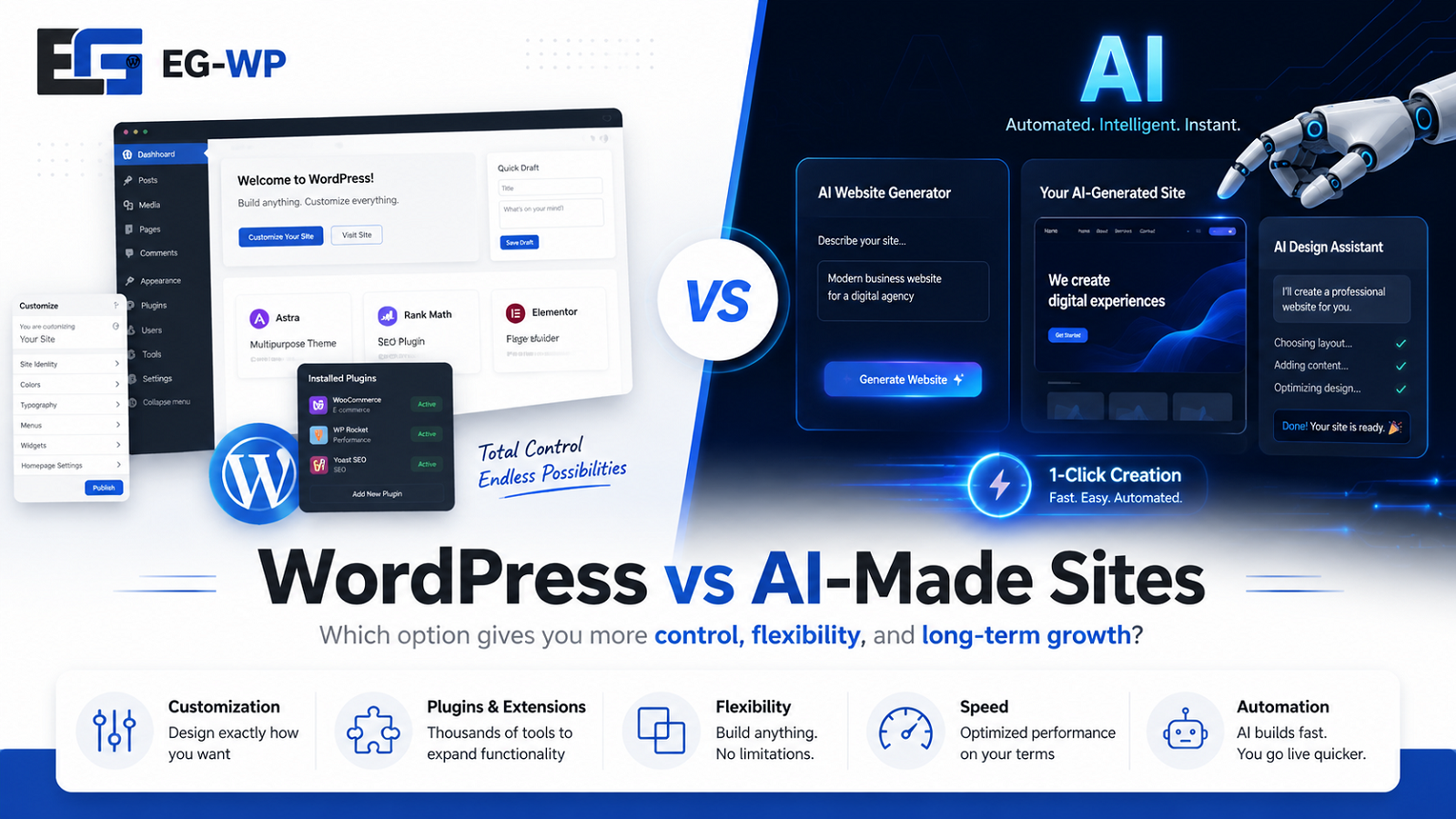
What Is an AI-Made Website?
An AI-made website is created partly or almost entirely through artificial intelligence. Instead of manually selecting every section, writing each paragraph, and configuring the layout, the user gives the system a description or answers several questions.
The AI builder may then generate:
- A homepage and supporting pages
- Written website content
- Images or visual suggestions
- Color and typography combinations
- Navigation menus
- Basic SEO titles and descriptions
- Contact forms or product sections
AI is now widely used within software development. Stack Overflow’s 2025 Developer Survey found that 84% of respondents were using or planning to use AI tools in their development process, while 51% of professional developers used AI tools daily. These figures indicate that AI-assisted creation is becoming a normal part of digital production rather than a temporary trend.
However, “AI-made” does not necessarily mean that every part of the website is unique, reliable, or ready to rank. AI-generated designs often rely on templates, reusable components, automated text, and the limitations of the platform producing them.
What Is a WordPress Website?
WordPress is an open-source content management system that allows users to build anything from a simple blog to a large membership platform or international e-commerce store.
A WordPress website can be customized through:
- Themes
- Plugins
- Page builders
- Custom code
- WooCommerce extensions
- SEO and analytics tools
- Caching and performance solutions
- Marketing and automation integrations
The ecosystem is also continuing to grow. During 2025, the official WordPress Plugins Team reviewed 12,713 plugin submissions, representing a 40.6% increase compared with 2024. By March 2026, WordPress was receiving more than 500 new plugin submissions per week, showing that development around the platform remains highly active.
For businesses using EG-WP, this ecosystem provides access to professional WordPress themes and plugin activations that can add advanced design, marketing, optimization, security, and e-commerce features without requiring every function to be developed from scratch.
The Main Difference
The central difference is control.
An AI builder prioritizes speed and simplicity. WordPress prioritizes flexibility, ownership, and extensibility.
AI website builders can be excellent for creating a fast starting point. WordPress is generally stronger when the website must become a long-term business asset that can evolve alongside the company.
The best choice therefore depends on whether you need only a quick online presence—or a platform you can continue expanding, optimizing, and monetizing for years.
WordPress vs AI Website Builders: Speed, Design, SEO, and Content
Choosing between WordPress and an AI-made website is not simply a question of which technology is newer. The better platform is the one that matches your business goals, technical requirements, and long-term marketing strategy.
1. Website-Building Speed
AI website builders win when the main priority is launching as quickly as possible.
A typical AI builder asks several questions about your company, industry, preferred colors, and required pages. It then produces an initial website automatically. This can reduce the time needed to create a basic homepage, contact page, service descriptions, and navigation structure.
WordPress usually requires more initial decisions, including:
- Choosing hosting and a domain
- Installing WordPress
- Selecting and activating a theme
- Adding the required plugins
- Configuring pages, menus, security, and backups
- Testing the website on desktop and mobile devices
However, WordPress does not always require weeks of development. Modern themes, block patterns, starter templates, and visual page builders can create a professional foundation quickly. The 2025 Web Almanac estimated that around 60% of WordPress sites use a page builder, with Elementor representing approximately 43% of observed mobile page-builder usage. This shows how widely businesses rely on visual tools to accelerate WordPress design without building every page through custom code.
Verdict: AI builders are usually faster for the first draft. WordPress is better when the website needs a carefully configured, expandable foundation.
2. Design Freedom and Customization
AI builders can generate attractive layouts, but users are normally limited to the sections, design controls, and integrations supported by that particular service.
This is useful for beginners because fewer options make the process easier. The disadvantage appears when the business needs something outside the platform’s standard features, such as:
- A custom checkout process
- Advanced product filtering
- Membership subscriptions
- Multilingual content
- Course management
- Marketplace functionality
- Specialized booking systems
- Custom marketing automations
WordPress offers significantly more flexibility because themes, plugins, APIs, page builders, and custom code can all work together. Its open architecture allows a website to gain new features without necessarily migrating to another platform.
The same flexibility creates responsibility. HTTP Archive’s 2025 CMS analysis found that WordPress performance varies widely according to configuration, themes, plugins, hosting, and page-builder choices. In other words, WordPress can be extremely fast and efficient, but installing too many poorly optimized tools can also produce a heavy website.
This makes professional theme and plugin selection especially important. EG-WP customers should choose solutions based on compatibility, update history, required functionality, and performance—not simply the number of features advertised.
3. SEO Capabilities
Both WordPress and reputable AI website builders can support basic SEO tasks such as editing page titles, meta descriptions, image alternative text, and URLs.
WordPress becomes stronger when a business needs advanced control over:
- XML sitemaps
- Canonical URLs
- Schema markup
- Redirects
- Breadcrumbs
- Indexing rules
- Internal linking
- WooCommerce product SEO
- Search Console integrations
- Social-sharing metadata
WordPress SEO plugins can place these controls inside an accessible dashboard, allowing marketers to optimize individual articles, product pages, categories, and landing pages.
However, installing an SEO plugin does not automatically produce high rankings. Google says its ranking systems prioritize helpful, reliable, people-first content, not pages created primarily to manipulate search positions.
Google also applies the same foundational SEO practices to its AI-powered search experiences. Websites still need crawlable pages, useful content, clear internal links, good page experience, and accurate structured information.
4. Is AI-Generated Content Bad for SEO?
AI-generated content is not automatically penalized.
Google’s guidance focuses on the purpose and quality of the content rather than whether a human or an AI tool produced the first draft. Generative AI can help with research, organization, summaries, and content structure. The risk begins when a website publishes large numbers of low-value pages mainly to capture search traffic. Google identifies this behavior as potential scaled content abuse.
AI-generated articles should therefore be reviewed by a knowledgeable person who can:
- Correct inaccurate statements
- Add first-hand knowledge
- Include original examples
- Verify statistics and sources
- Remove repetition
- Match the company’s real products and services
- Improve the content for the intended reader
For EG-WP, AI can support the writing process, but the final content should demonstrate real WordPress knowledge. Articles should explain how themes and plugins solve specific business problems rather than publishing generic descriptions that could appear on any competing website.
5. Performance and Core Web Vitals
Google’s Core Web Vitals measure loading performance, responsiveness, and visual stability. Google recommends an LCP of no more than 2.5 seconds, an INP below 200 milliseconds, and a CLS score below 0.1 for a good user experience.
Managed AI builders often provide consistent hosting and optimization automatically. WordPress gives the site owner more control, but performance depends on implementation.
In HTTP Archive’s 2025 mobile data, approximately 53% of WordPress sites achieved a good LCP score, while about 45% passed all three Core Web Vitals assessments. WordPress improved year over year, but the results show that optimization cannot be ignored.
A strong WordPress setup should combine a lightweight theme, reliable hosting, image compression, caching, limited third-party scripts, and carefully selected plugins. This is where choosing the correct products can matter more than choosing the platform name alone.
WordPress vs AI-Made Sites for E-Commerce, Ownership, Security, and Cost
A website may begin as a simple digital brochure, but successful businesses often need more later: online payments, customer accounts, subscriptions, multilingual pages, marketing automation, advanced analytics, or integrations with external systems.
This is where the difference between WordPress and many AI website builders becomes more noticeable.
6. E-Commerce Capabilities
Many AI website builders can generate a basic online store with product pages, a shopping cart, and standard payment options. This may be enough for a small seller with a limited catalog and a simple checkout process.
The limitations usually appear when the store needs more specialized functionality, such as:
- Product bundles and variations
- Wholesale or role-based pricing
- Recurring subscriptions
- Membership access
- Digital product delivery
- Advanced coupons
- Multi-vendor marketplaces
- Custom checkout fields
- Product comparison tools
- Local payment gateways
- Detailed shipping rules
WordPress stores normally use WooCommerce, an open-source e-commerce platform built specifically for WordPress. In July 2026, W3Techs reported that WooCommerce was used by 8.2% of all websites and represented 48.6% of the e-commerce systems detected in its surveys. Woo also states that its platform powers more than 4 million online stores.
WooCommerce is not automatically the right solution for every seller. It requires configuration, maintenance, and suitable hosting. However, its extension ecosystem gives store owners much greater control over how products are displayed, purchased, delivered, and marketed.
WooCommerce also includes customizable analytics for monitoring sales, orders, products, customers, coupons, taxes, and other performance indicators. Reports can be filtered by date, compared with previous periods, and exported as CSV files for further analysis.
Verdict: An AI builder may be suitable for launching a small, straightforward store. WordPress and WooCommerce are generally stronger for businesses that expect their e-commerce requirements to become more complex.
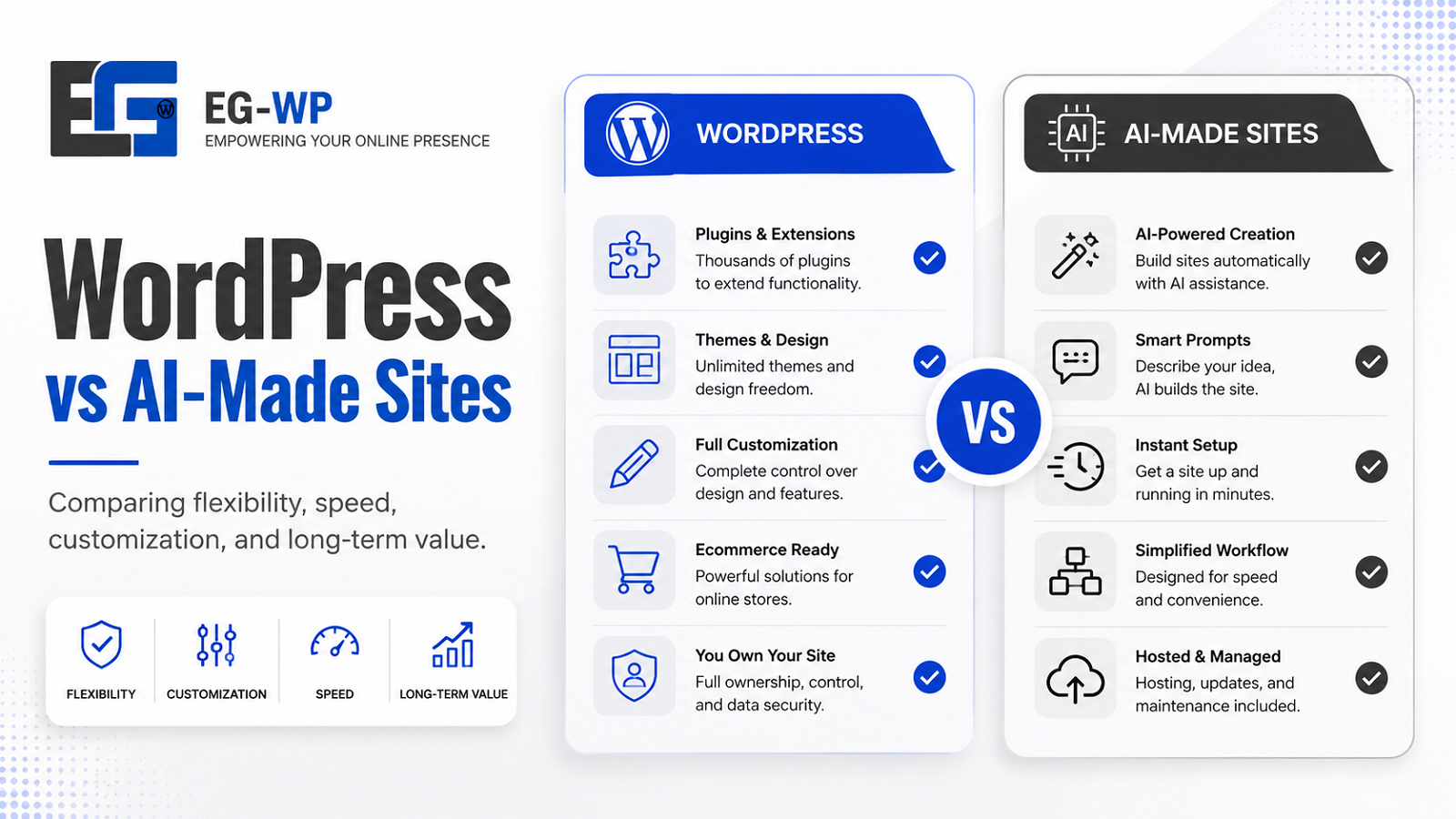
7. Website Ownership and Portability
Ownership is one of the most important differences in the WordPress vs AI-made sites debate.
Self-hosted WordPress is open-source software that can be downloaded and installed on different web hosts. It is licensed under the GPL, allowing people to use and modify the software without being tied to one hosting provider.
With a self-hosted WordPress website, the business can generally control:
- Its hosting provider
- Website files
- WordPress database
- Themes and plugins
- Backups
- Domain settings
- Custom code
- Migration process
Many hosted AI builders operate as closed platforms. The user may own the business content they upload, but the generated layout, platform features, hosting environment, and editing system can remain dependent on that provider.
Export options vary between services. Moving away may require rebuilding parts of the website, especially when the original site relies on proprietary AI-generated components.
This does not make hosted platforms bad. They reduce technical responsibility and provide a managed environment. The trade-off is that convenience can create platform dependence.
8. Security and Maintenance
AI website builders usually manage server maintenance, platform patches, and much of the technical security in the background. This makes them attractive to beginners who do not want to manage software updates.
WordPress gives owners more control, but that control comes with responsibility. The site owner or administrator must maintain:
- WordPress core
- Themes and plugins
- Hosting security
- Backups
- Administrator accounts
- Malware protection
- Login security
The 2026 State of WordPress Security report recorded 11,334 newly identified ecosystem vulnerabilities during 2025, a 42% increase from 2024. Approximately 91% were found in plugins, 9% in themes, and only six low-priority issues were reported in WordPress core.
These numbers do not mean that every WordPress website is unsafe. They show why plugin quality and maintenance matter. A site using outdated, abandoned, or untrustworthy extensions has a different risk profile from one using carefully selected products, active updates, secure hosting, backups, and limited administrator access.
WordPress supports automatic updates for themes and plugins, while minor maintenance and security updates can also be applied automatically.
For EG-WP customers, security should be part of every purchasing decision. Before activating a theme or plugin, check its compatibility, update process, documentation, licensing conditions, and support terms. Avoid installing unnecessary extensions simply because they are available.
9. Scalability and Integrations
AI builders are often easiest at the beginning because hosting, editing, and publishing are combined in one service. However, a business may eventually need features that the platform does not support.
WordPress can connect with a broad range of external services through plugins, APIs, and custom development. These may include:
- Email marketing platforms
- Customer relationship management systems
- Payment processors
- Learning management systems
- Analytics tools
- Booking systems
- Accounting software
- Shipping providers
- Automation platforms
This makes WordPress particularly useful for agencies, growing e-commerce businesses, publishers, membership sites, and companies with specialized workflows.
The disadvantage is that more integrations can increase technical complexity. Every additional plugin must be evaluated for performance, security, compatibility, and long-term maintenance.
10. Long-Term Cost
An AI website builder usually charges a monthly or annual subscription. Hosting, maintenance, templates, and AI tools may be bundled together, making expenses easier to predict.
However, higher plans may be required for e-commerce, additional storage, advanced analytics, custom integrations, removal of platform branding, or increased usage.
WordPress itself is free, but operating a professional website may involve separate costs for:
- Domain registration
- Web hosting
- Premium themes
- Plugin activations
- Security and backups
- Development or maintenance
- Performance optimization
WordPress is not always cheaper at the beginning. Its financial advantage is flexibility: businesses can choose their hosting, replace tools, upgrade individual features, and avoid depending entirely on one platform’s pricing structure.
The better question is therefore not, “Which option has the lowest starting price?” It is, “Which option provides the best value for the website this business will need in two or three years?”
WordPress vs AI-Made Sites: Final Comparison and Verdict
AI website builders are useful, fast, and increasingly capable. However, speed alone does not determine whether a website will support a business successfully over the long term.
WordPress remains a major part of the modern web. In July 2026, W3Techs reported that WordPress powered approximately 41.5% of all websites and held around 59.2% of the known content management system market. Its continuing popularity is supported by a large ecosystem of developers, themes, plugins, hosting providers, agencies, and educational resources.
WordPress vs AI Website Builders Comparison
| Feature | WordPress | AI-Made Website |
|---|---|---|
| Initial setup | Requires configuration | Usually generated within minutes |
| Ease of use | Moderate learning curve | Beginner-friendly |
| Design control | Extensive | Depends on the platform |
| Plugin support | Very large ecosystem | Limited to supported integrations |
| Advanced SEO | Strong control through plugins and settings | Usually provides basic or moderate controls |
| E-commerce | Highly customizable with WooCommerce | Suitable for simpler stores |
| Website ownership | Greater control with self-hosting | Often dependent on the provider |
| Portability | Can usually move between hosts | Export options may be limited |
| Maintenance | Owner manages updates and backups | Mostly managed by the platform |
| Scalability | Suitable for simple and complex websites | Depends on platform limits and pricing |
| Custom development | Widely supported | Often restricted |
| Best for | Growing and specialized websites | Fast, simple website launches |
Who Should Choose an AI-Made Website?
An AI website builder may be suitable when:
- You need a basic website online immediately.
- You have little technical experience.
- Your website requires only a few standard pages.
- You do not expect to add complex functionality.
- You prefer one subscription that includes hosting and maintenance.
- You are creating a temporary project or testing a business idea.
AI can also help experienced designers and developers produce first drafts, page structures, placeholder copy, and design concepts more efficiently.
However, every generated page should still be reviewed. AI can produce repetitive writing, unsupported claims, factual errors, inconsistent branding, and generic layouts. Publishing the first generated result without editing may create a website that looks similar to many competitors.
Who Should Choose WordPress?
WordPress is usually the stronger option when:
- The website is a long-term business asset.
- Organic search traffic is important.
- The business needs advanced landing pages or content marketing.
- The store requires customized products, payments, shipping, or checkout rules.
- The owner wants control over hosting and website files.
- The website must connect with external marketing or business tools.
- New features are likely to be required later.
- A developer may need to customize the website.
WordPress is released under the GPLv2-or-later license, and its open-source model gives users broad freedom to run and modify the software. This is a major advantage for businesses that want to avoid being permanently dependent on one proprietary website platform.
For online sellers, WooCommerce adds a flexible, open-source commerce system to WordPress. Woo reports more than 4.1 million live installations, over 1,500 official marketplace products, and approximately 30.5% of e-commerce usage, based on the sources presented in its company statistics.
Is WordPress Better Than AI?
WordPress and AI should not always be treated as opposing technologies.
The strongest approach for many businesses is an AI-assisted WordPress website.
AI can support:
- Keyword and topic research
- Content outlines
- First-draft copy
- Product description ideas
- Image concepts
- Code suggestions
- Customer support automation
- Internal linking recommendations
WordPress can then provide the publishing system, design framework, SEO controls, store functionality, data ownership, and long-term scalability.
This combination offers the speed of AI without giving up the control of an open website platform.
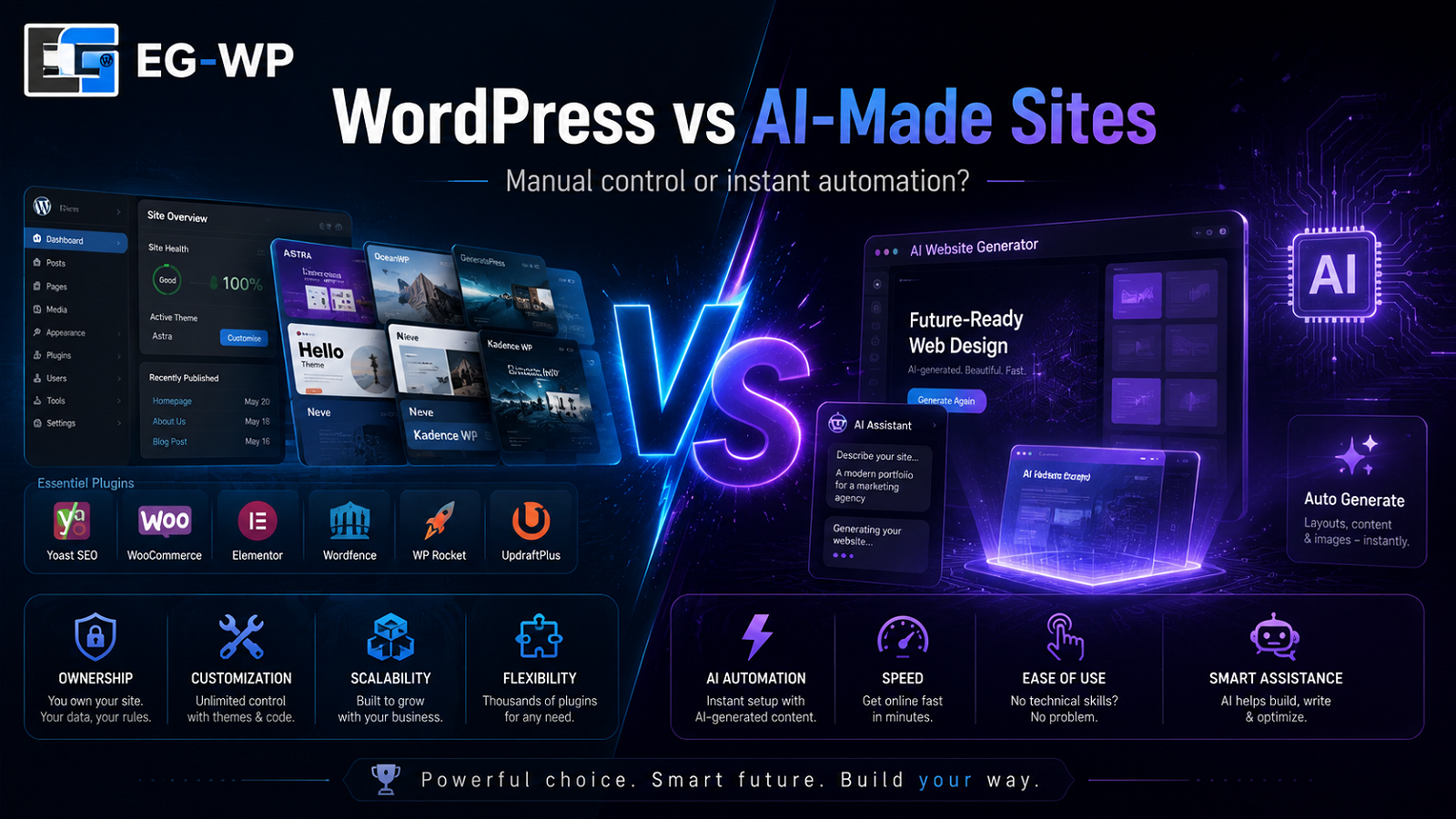
Which Platform Is Better for SEO?
WordPress generally provides more detailed SEO control, but neither platform receives an automatic ranking advantage simply because of the software used.
Google recommends creating original, helpful, reliable, people-first content. It allows the responsible use of generative AI, but warns that creating large numbers of pages without adding meaningful value may violate its scaled-content-abuse policies.
Google also confirms that established SEO practices remain relevant to AI Overviews, AI Mode, and other generative search experiences. Websites still benefit from crawlable pages, accurate information, clear structure, good user experience, and content that answers real questions.
Therefore, the best SEO platform is the one that helps you consistently publish useful content while maintaining good technical performance.
Frequently Asked Questions
Can an AI website rank on Google?
Yes. Google does not exclude a website because an AI builder created it. Its pages must still be crawlable, useful, original, technically sound, and relevant to the searcher.
Does Google penalize AI-generated content?
Google does not automatically penalize content for using AI. The risk comes from publishing inaccurate, copied, repetitive, or mass-generated content that provides little value.
Is WordPress difficult for beginners?
WordPress has a larger learning curve than most automated builders. Modern themes, page builders, starter templates, and professionally configured plugins can make it much easier to manage.
Can WordPress use artificial intelligence?
Yes. WordPress can use AI for writing assistance, image creation, chatbots, automation, SEO recommendations, translations, product descriptions, and other tasks through plugins and external services.
Is WordPress suitable for an online store?
Yes. WordPress and WooCommerce can support digital products, physical products, subscriptions, memberships, bookings, variable products, coupons, and many other e-commerce models.
Are AI website builders cheaper than WordPress?
They may have a lower or simpler starting cost. Long-term costs depend on subscription levels, transaction fees, storage, traffic, e-commerce features, premium integrations, hosting, and maintenance requirements.
Final Verdict
Choose an AI website builder when your priority is producing a simple website with minimal setup.
Choose WordPress when you need ownership, advanced customization, strong content management, specialized e-commerce features, and room for future growth.
For most businesses building a serious long-term online presence, WordPress remains the more flexible option. AI should be used to accelerate research, design, writing, and administration—not necessarily to replace the entire platform.
Build a More Powerful WordPress Website with EG-WP
EG-WP helps website owners access WordPress theme and plugin activation options for design, marketing, e-commerce, performance, security, and website management.
Instead of accepting the limitations of a basic generated website, you can develop a WordPress platform that matches your brand and business requirements.
Explore the available solutions on EG-WP, carefully review each product’s features, compatibility, update conditions, support terms, and licensing details, and select the tools your website actually needs.
Build faster with AI. Grow with WordPress. Power your website with EG-WP.


No comment