







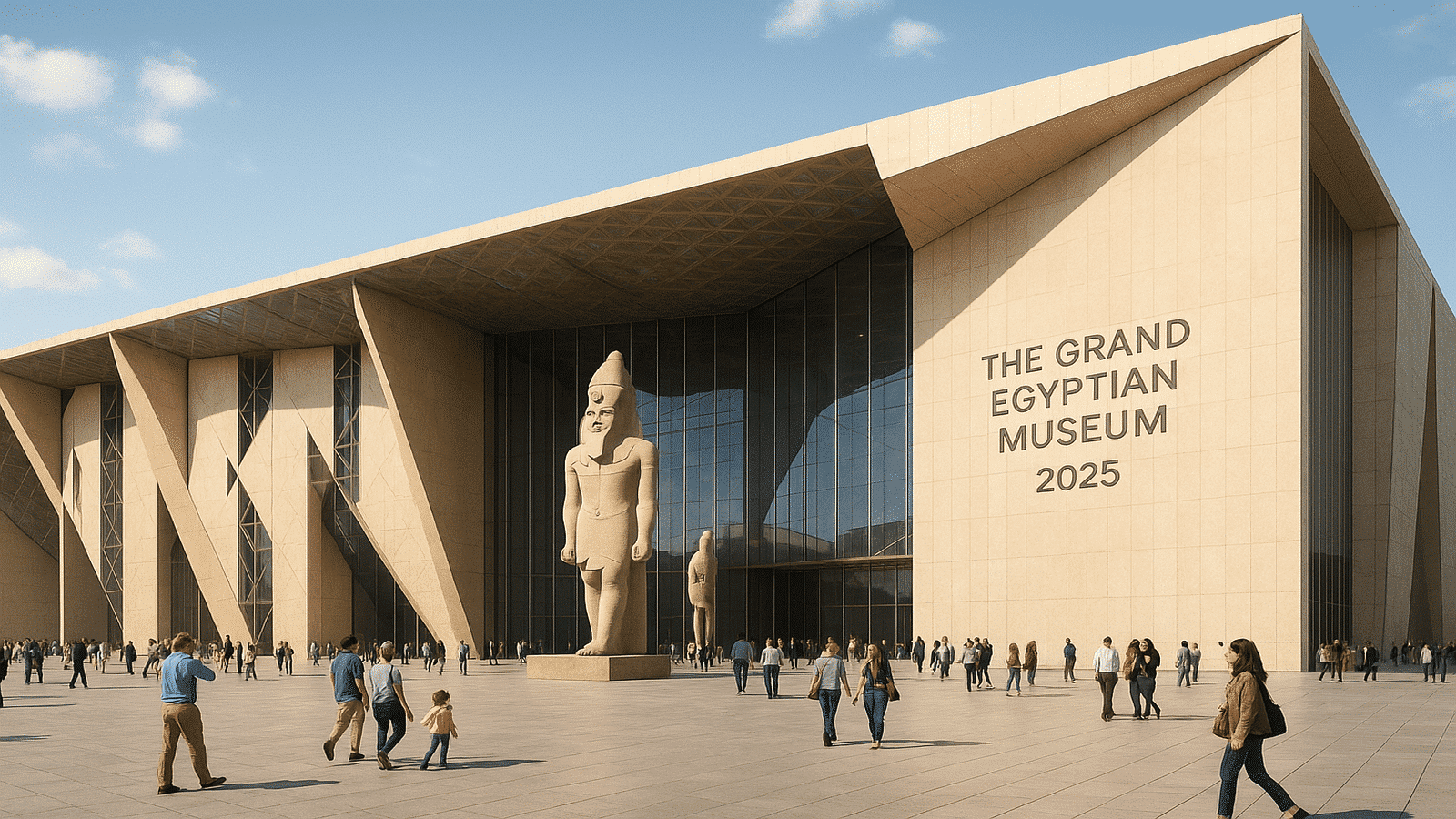
The Grand Egyptian Museum Location
The Grand Egyptian Museum (GEM)
The Icon of Modern Egypt and the Jewel of Ancient Civilization
At the foot of the towering Pyramids, where history intersects with the future, stands the Grand Egyptian Museum (GEM) as the greatest cultural project of the twenty-first century. It is not merely a museum displaying the relics of the Pharaohs, but an integrated cultural city that combines science, art, and engineering, embodying Egypt’s new vision for re-presenting its global heritage in a contemporary manner.
This gigantic edifice, which took more than twenty years to construct, reflects the will of the Egyptians to build a civilizational bridge connecting their glorious past with their ambitious future. In this article, we will delve into the project’s details: from the initial idea to the opening, passing through the architectural design, rare collections, advanced technology, and the touristic and economic impact of the Museum on Egypt and the world.

The Location of the Grand Egyptian Museum and its Strategic Importance
The Grand Egyptian Museum
The Grand Egyptian Museum is located on the Giza Plateau, just about two kilometers from the Pyramids complex, in an area carefully selected to be a meeting point between modern Cairo and ancient Egypt.
The visitor coming from the capital sees the Pyramids on the horizon while approaching the Museum, living a visual experience that merges the past with the present.
The selection of this location was not a coincidence; the Egyptian government conducted studies that lasted more than three years to determine the best point that would allow the establishment of a world-class museum without disturbing the archaeological scene of the Pyramids.
The current location was chosen for several reasons:
- Its proximity to the Ring Road and the 26th of July Corridor makes it easy to access from any area in Greater Cairo.
- Its proximity to the new Sphinx International Airport which facilitates the arrival of international visitors directly to Giza.
- Its direct visual connection to the Pyramids, which allows the visitor to experience an integrated journey through Egyptian civilization without leaving the site.
The Museum is part of a broader project to develop the Pyramids Plateau area and transform it into an integrated global tourist destination that includes hotels, restaurants, commercial centers, and a massive tourist walkway connecting the Museum and the Pyramids.
Project Idea and Beginnings
The idea of establishing the Grand Egyptian Museum was born in 1992 after the Egyptian government realized that the Egyptian Museum in Tahrir, founded in 1902, was no longer capable of accommodating the vast amount of newly discovered artifacts.
In 1998, Egypt announced a global architectural competition to design a museum worthy of the greatness of its history. More than 1557 design offices from 83 countries participated, and it was won by the Irish architectural firm Heneghan Peng Architects, who presented an innovative vision that blends Egyptian authenticity with modern engineering.
In 2005, the foundation stone was laid with an official Egyptian and international presence, marking the start of work on the project that later became the largest archaeological museum in the world dedicated to a single civilization.
Construction Period and Project Timelines
The construction of the Grand Egyptian Museum spanned over twenty years (2005 – 2025), passing through several stages:
First Stage (2005 – 2010):
- Began with leveling and excavation work and the preparation of the infrastructure for a massive site covering an area of about 500,000 square meters (50 hectares).
- During this period, the basic structures for the main building, storage facilities, and the restoration center were built, at an estimated cost exceeding 300 million US dollars.
Second Stage (2011 – 2015):
- Witnessed a temporary slowdown due to political events in Egypt, but work continued on equipping the Global Restoration Center, which later became one of the largest restoration centers in the Middle East, housing more than 19 specialized laboratories for restoring ancient wood, metals, stones, and textiles.
Third Stage (2016 – 2020):
- In this stage, the external structure and the famous triangular glass façade were completed, in addition to equipping the smart lighting system and climate control inside the halls to protect the artifacts.
- This period also saw the transfer of more than 50,000 artifacts from the old Museum and the stores of Saqqara and the Citadel.
Fourth Stage (2021 – 2025):
- Included interior finishes, testing of display systems, and the construction of conference halls, restaurants, and commercial stores.
- At the end of 2025, the Museum began its pilot opening in preparation for the eagerly awaited full opening soon.
In total, the project took more than 22 years from idea to operation, at an estimated cost of approximately one billion US dollars, with joint funding from the Egyptian Government and the Japan International Cooperation Agency (JICA).
Supervising, Funding, and Implementing Bodies
1. Funding and Management
- The Japan International Cooperation Agency (JICA) provided a concessional loan of nearly 800 million US dollars.
- The Egyptian Government financed a large percentage of the infrastructure and logistical services.
- The Ministry of Tourism and Antiquities is the entity responsible for management and operation.
2. Implementation and Supervision
- The Egyptian Armed Forces Engineering Authority took full supervision of the construction operations and coordination between the companies.
- The implementing alliance included the companies Orascom Construction and Arab Contractors in cooperation with Japanese companies specialized in precise construction.
- Technical and administrative supervision was undertaken by the American firm Hill International in cooperation with the Danish office Ramboll.
Architectural Design and Visual Symbolism
The Museum’s design is considered one of the greatest architectural projects in the world, blending contemporary engineering with the symbolic thought of Egyptian civilization.
The most prominent design elements:
The Triangular Glass Façade:
- Designed with semi-transparent stone panels in golden gradations, reflecting sunlight in a way that resembles the sparkle of Egyptian sands.
The Grand Staircase:
- Extends for 60 meters, featuring colossal statues of Pharaohs lined up on its sides, as if the visitor is climbing the ladder of time towards the peak of civilization.
The Grand Hall:
- Welcomes the visitor with the famous statue of Ramesses II, weighing 83 tons and 11 meters tall, which was transferred from Ramesses Square in 2018 in a precise international engineering operation.
Energy and Sustainability:
- The Museum was designed to be environmentally friendly using solar energy and natural ventilation systems, and relies on modern technologies to reduce energy consumption by 30%.
Total Area:
- The internal display area is more than 92 thousand square meters, making GEM the largest museum in the world dedicated to a single civilization.
Archaeological Collections and Rare Treasures
The Museum houses more than 100,000 artifacts covering all Egyptian eras from the Predynastic periods until the Greco-Roman era.
Among the most notable:
The Full Tutankhamun Collection:
- More than 5,000 pieces displayed for the first time in one place, including the Golden Mask, the Royal Chariot, and the Funerary Bed.
Colossal Statues:
- Statues of Ramesses II, Amenhotep III, and Queen Hatshepsut in a majestic display reflecting power and greatness.
Daily Life Artifacts:
- Agricultural tools, jewelry, medical instruments, and papyri that show the details of the daily lives of ancient Egyptians.
The Royal Mummies Hall:
- Displayed in a way that respects the human aspect, explaining the mummification processes in an interactive scientific manner away from the macabre nature.
Pieces Not Previously Displayed:
- About 20 thousand pieces are displayed for the first time, many of which were recently discovered in the Saqqara and Luxor areas.
The Global Restoration Center
The Restoration Center at the Grand Egyptian Museum is the largest of its kind in the Middle East, located in the basement of the building over an area of 30 thousand square meters.
It houses specialized laboratories for wood, textiles, metals, and bones, and an X-ray and chemical analysis lab.
Egyptian and Japanese experts participated in its establishment within a technical partnership with the University of Tokyo.
To date, more than 40 thousand artifacts have been restored inside it, some of which have not been displayed for thousands of years.
The Tourist Experience Inside the Museum
A visit to the Grand Egyptian Museum is a multi-sensory experience, combining visual awe with historical knowledge:
- Audio guides in 15 languages.
- A smart application that guides visitors through internal maps.
- Dedicated areas for children to teach Egyptian civilization through play.
- Three-dimensional shows (3D Holograms) to explain how the Pyramids were built.
- Luxury restaurants with direct views of the Giza Pyramids.
- Gift and jewelry shops inspired by Pharaonic inscriptions.
- Conference halls and an educational cinema seating 500 visitors.
The Economic and Cultural Impact of the Museum
1. Touristic Dimension
- The Museum is expected to attract more than 5 million visitors annually, increasing cultural tourism revenues by 25% annually.
2. Economic Dimension
- The project created more than 15 thousand direct job opportunities, and 30 thousand indirect opportunities in the fields of construction, restoration, and tourist services.
3. Cultural Dimension
- The Museum is a platform for educating new generations and connecting them with the roots of Egyptian identity, with the organization of educational workshops and academic programs for students and researchers.
Technology and Innovation
The Museum is not only an archaeological edifice but a sophisticated technological laboratory relying on:
- Smart Lighting Systems and control.
- Multi-touch interactive screens to explain historical stories.
- The use of Augmented Reality (AR) and Virtual Reality (VR) in the exhibition halls.
- An integrated climate monitoring system to protect pieces from humidity and heat.
Global Comparison
GEM is larger than the Louvre Museum in Paris in terms of internal display area, and larger than the British Museum in terms of the number of pieces on display.
But its true distinction lies in being a museum of a single civilization at its original site, while other museums rely on collections transferred from different countries.

Sustainable Development and the Museum’s Surroundings
The Giza area has been transformed into a comprehensive development project aimed at making it a global destination for sustainable culture and tourism, including:
- The construction of a five-star hotel adjacent to the Museum.
- The development of the road and transport network, including a new metro station.
- The creation of the “Cultural Pyramids Walkway” that connects the Museum to Pyramids Square.
- Green areas and open gardens to host events and celebrations.
The Future Vision
The Grand Egyptian Museum aims to become:
- A global center for research and education in Egyptology.
- A platform for international cultural exchange through temporary exhibitions with the world’s museums.
- A sustainable destination relying on clean energy and smart technologies.
In the near future, the Museum will launch an electronic application for bookings and virtual tours, and plans to host global events such as culture and archaeology conferences.
Advice for Visitors
- The best time to visit is early morning to enjoy the tranquility and natural lighting.
- Book your ticket in advance via the official website to avoid crowds.
- Dedicate a full day to the visit, as the Museum is vast and worth the time for exploration.
- Do not miss the Tutankhamun Hall, and the Grand Staircase overlooking the Pyramids.
- Evening visits are recommended to experience the stunning night lighting.
Conclusion
The Grand Egyptian Museum is not just an architectural project or a tourist destination; it is a symbol of modern Egypt’s renaissance and a message to the world that civilization does not die, but renews itself.
In its halls, the genius of the ancient Egyptian blends with the creativity of the modern architect, giving birth to a place that inspires the visitor and invites contemplation on a journey that spanned seven thousand years.
If you are looking for an experience that combines majesty, knowledge, and enjoyment, a visit to the Grand Egyptian Museum is not an option… but a duty for every lover of history and humanity.



No comment