






Is WordPress Dying? The Truth About the World’s Most Popular CMS
If you’ve spent any time in web development communities recently, you’ve probably seen headlines like:
- “WordPress is losing market share.”
- “Website builders are replacing WordPress.”
- “AI will kill WordPress.”
- “Developers are moving to modern frameworks.”
These statements have caused many website owners to wonder:
Is WordPress dying?
The short answer is:
No—but the ecosystem is changing faster than ever before.
WordPress isn’t disappearing. In fact, it still powers more websites than every other Content Management System (CMS) combined. However, the way people build websites has evolved dramatically over the last few years.
New competitors like Shopify, Wix, Squarespace, Webflow, Framer, and AI-powered website builders have changed the market. Meanwhile, WordPress itself has undergone major transformations with the introduction of Gutenberg, Full Site Editing (FSE), block themes, and a more modern development approach.
For business owners, bloggers, agencies, and developers, understanding these changes is far more important than believing sensational headlines.
In this article, we’ll examine real-world statistics, industry trends, and expert opinions to determine whether WordPress is actually dying—or simply evolving into its next chapter.
The Numbers Tell a Different Story
Whenever someone claims WordPress is “dead,” it’s worth looking at the data first.
The statistics paint a very different picture.
As of 2026:
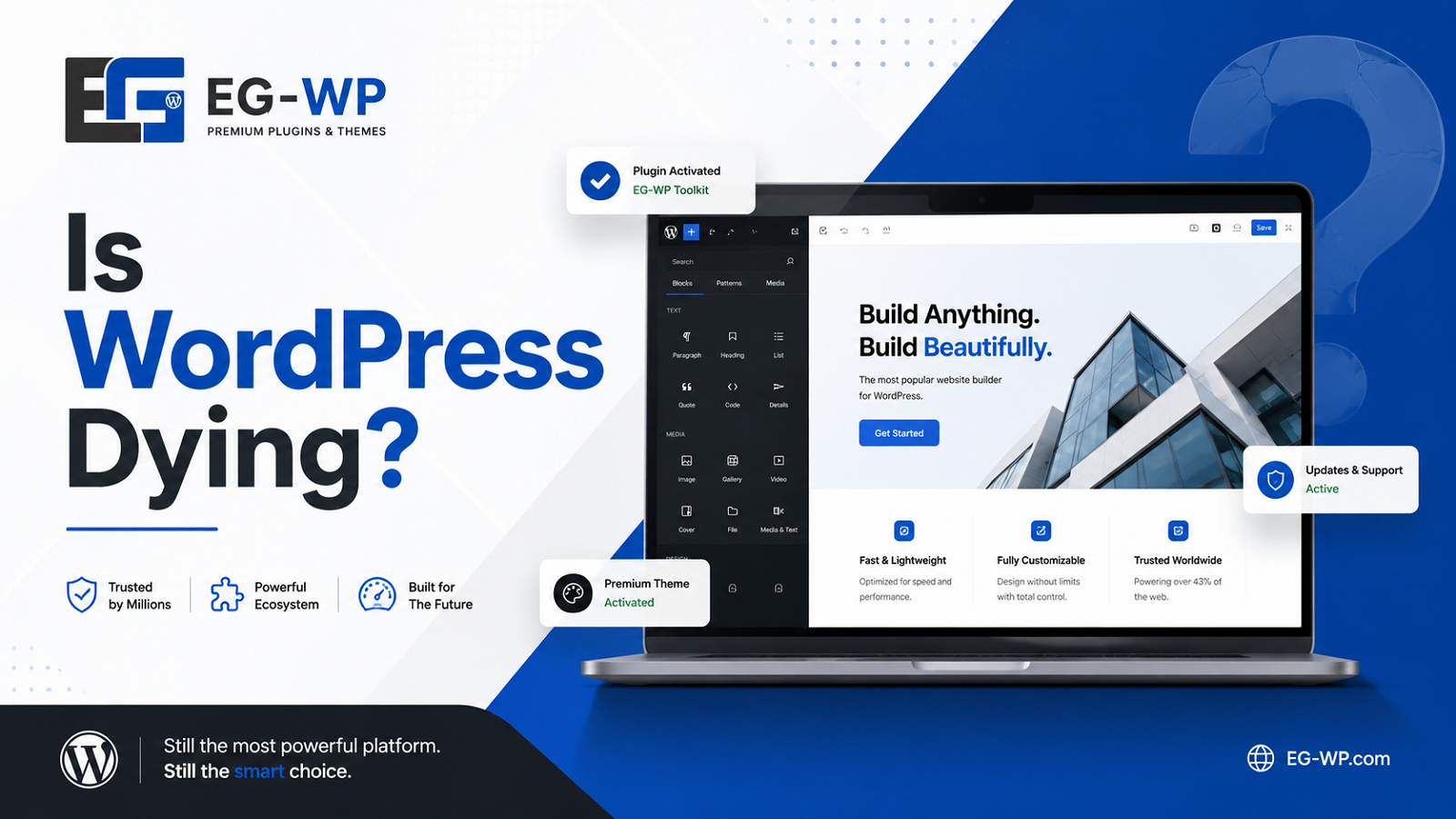
- WordPress powers approximately 43% of all websites on the internet.
- Among websites using a known CMS, WordPress controls well over 60% of the market.
- Millions of new WordPress websites are launched every year.
- Tens of thousands of businesses depend on WordPress for ecommerce, publishing, education, membership platforms, and enterprise applications.
To put that into perspective:
If you randomly visit 100 websites on the internet, around 43 of them are likely powered by WordPress.
No other CMS comes remotely close.
WordPress Still Dominates the CMS Market
Let’s compare WordPress to some of its biggest competitors.
Even if you combine several competing platforms together, WordPress still remains the largest CMS ecosystem in the world.
That isn’t the profile of a dying platform.
It’s the profile of a mature platform facing increasing competition.
Why Do People Think WordPress Is Dying?
There are several reasons this question keeps appearing.
1. More Competition Than Ever
Ten years ago, WordPress had relatively few serious competitors.
Today, users can choose from:
- Shopify
- Wix
- Squarespace
- Webflow
- Framer
- Ghost
- HubSpot CMS
- AI website builders
Each platform targets a different audience.
Someone who wants a simple portfolio may choose Framer.
An online retailer with minimal technical experience might choose Shopify.
A designer focused on visual editing may prefer Webflow.
This increased competition naturally reduces WordPress’s growth rate—but it doesn’t mean WordPress is shrinking.
2. AI Website Builders Are Changing Expectations
Artificial intelligence has made website creation easier than ever.
Users can now generate:
- landing pages
- product descriptions
- blog posts
- layouts
- images
- marketing copy
within minutes.
Many AI tools even promise to build entire websites automatically.
However, AI still requires a platform to publish content.
In many cases, that platform is still WordPress.
Instead of replacing WordPress, AI often enhances it through plugins, automation tools, and content generation workflows.
3. Developers Are Talking About Modern Frameworks
JavaScript frameworks like:
- React
- Next.js
- Astro
- Nuxt
- Remix
have become extremely popular.
Large technology companies increasingly build custom applications rather than traditional CMS websites.
This has led some developers to assume WordPress is becoming obsolete.
The reality is more nuanced.
Most small businesses don’t need a complex React application.
They need:
- a blog
- an online store
- booking functionality
- SEO tools
- easy content editing
WordPress continues to excel in these areas.
The Size of the WordPress Ecosystem
One of WordPress’s biggest strengths isn’t just the software itself.
It’s the ecosystem.
Consider everything built around WordPress:
- More than 70,000 plugins
- Thousands of premium themes
- Millions of developers
- Agencies worldwide
- Hosting providers
- SEO specialists
- WooCommerce experts
- Page builders
- Security companies
- Learning resources
- Marketplace businesses
Entire companies exist solely because WordPress exists.
Examples include:
Together, these businesses generate billions of dollars annually.
A platform supporting such a massive economy isn’t disappearing overnight.
WordPress Continues to Power Major Brands
Another common misconception is that WordPress is only suitable for bloggers or hobby websites.
In reality, WordPress powers websites for:
- international corporations
- universities
- government organizations
- publishers
- news websites
- nonprofits
- ecommerce businesses
Many organizations choose WordPress because it offers something that proprietary website builders cannot:
Complete ownership.
Unlike closed platforms, WordPress allows businesses to:
- own their data
- move hosting providers
- customize every aspect of their website
- install virtually any functionality
- scale without vendor lock-in
For many organizations, that flexibility is invaluable.
Is WordPress Losing Users?
This question deserves a careful answer.
WordPress isn’t necessarily losing users in absolute numbers.
Instead, its percentage growth has slowed because the total number of websites created with alternative platforms has increased dramatically.
Think of it this way.
Imagine a city where one restaurant serves 90% of customers.
Years later, dozens of new restaurants open.
The original restaurant may now serve 70% of customers—even though it actually serves more people than before.
That’s similar to what’s happening with WordPress.
The internet has expanded.
Competition has expanded.
WordPress remains the largest player.
The Challenges Facing WordPress (And Why They Don’t Mean It’s Dying)
So why do so many people believe WordPress is dying?
The answer lies in the major changes the platform—and the web development industry—have experienced over the past several years.
Let’s examine the biggest challenges WordPress faces and whether they truly threaten its future.
Why Some Users Are Leaving WordPress
WordPress has never been a “perfect” platform. Like any mature software ecosystem, it has strengths and weaknesses.
Some users move to alternative platforms for legitimate reasons.
1. The Learning Curve
One of WordPress’s greatest advantages is also one of its biggest challenges.
It gives users complete control over their websites.
That flexibility comes with complexity.
A typical WordPress website may involve:
- Choosing a hosting provider
- Installing WordPress
- Selecting a theme
- Installing plugins
- Configuring backups
- Optimizing security
- Improving performance
- Managing updates
- Setting up SEO
For beginners, that can feel overwhelming.
By comparison, platforms like Wix and Squarespace offer a much simpler experience. Users can sign up, choose a template, and start editing immediately without worrying about hosting or maintenance.
For small personal websites, that convenience is attractive.
However, businesses that expect to grow often discover that the simplicity of closed platforms comes at the cost of flexibility and scalability.
2. Plugin Compatibility Issues
The WordPress ecosystem includes tens of thousands of plugins developed by different companies and independent developers.
While this variety is one of WordPress’s greatest strengths, it can occasionally lead to compatibility issues.
For example:
- A plugin update may conflict with another plugin.
- A theme update may introduce layout problems.
- PHP version changes may affect older plugins.
- Major WordPress updates sometimes require developers to adapt their products.
Although these issues are generally manageable, they contribute to the perception that WordPress requires ongoing maintenance.
This is why choosing well-maintained plugins and premium themes from trusted developers is essential.
3. Security Concerns
Another common criticism is that WordPress is insecure.
The truth is more nuanced.
The WordPress core software is actively maintained by a dedicated security team and receives regular updates.
In most cases, security vulnerabilities come from:
- Outdated plugins
- Abandoned themes
- Weak passwords
- Poor hosting environments
- Pirated software
- Incorrect server configurations
A properly maintained WordPress website can be extremely secure.
In fact, many security incidents attributed to WordPress stem from websites running outdated software or unsupported plugins.
Regular updates, trusted hosting, and reputable premium plugins significantly reduce these risks.
The Gutenberg Revolution
Perhaps no change has generated more debate than the introduction of the Gutenberg Block Editor.
When Gutenberg replaced the Classic Editor, many long-time users were frustrated.
Developers had to rethink workflows.
Theme creators had to redesign products.
Plugin developers had to update compatibility.
Initially, the transition felt disruptive.
However, Gutenberg represented a long-term strategy rather than a temporary redesign.
Today, block editing allows users to:
- Build pages visually
- Create reusable content blocks
- Edit layouts without coding
- Design templates directly inside WordPress
- Customize headers and footers without third-party page builders
While adoption wasn’t immediate, Gutenberg has matured significantly and continues to improve with each WordPress release.
For new users entering the ecosystem today, the block editor often feels like a natural way to build websites.
Full Site Editing (FSE): A New Direction
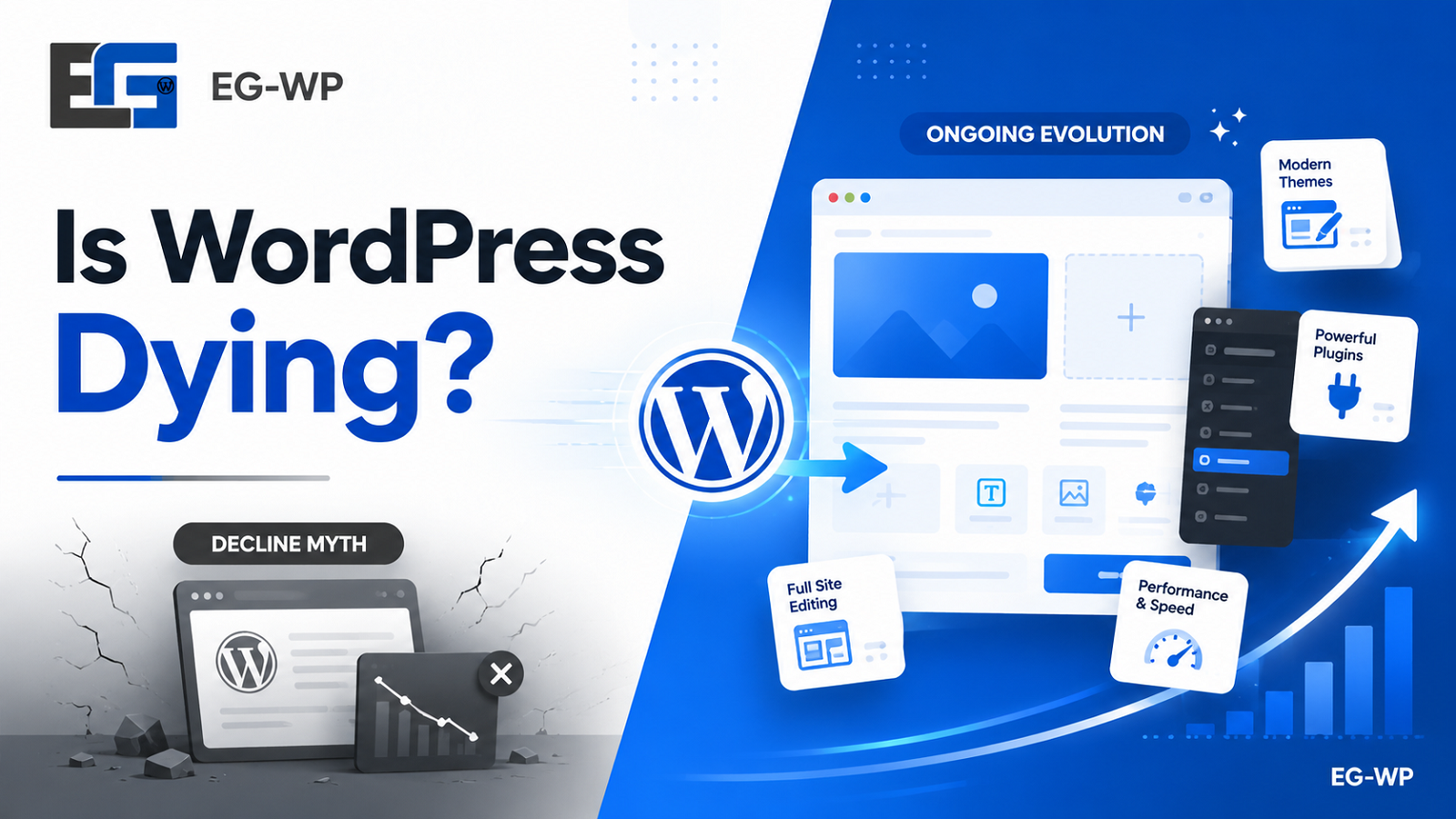
Building on Gutenberg, WordPress introduced Full Site Editing (FSE), allowing users to customize nearly every part of their website using blocks.
Instead of relying solely on PHP template files, users can now edit:
- Headers
- Footers
- Archive pages
- Single post templates
- Navigation menus
- Global styles
- Layouts
This brings WordPress closer to the visual editing experience offered by competitors while preserving the flexibility of an open-source platform.
Although many developers still prefer traditional themes for certain projects, Full Site Editing is steadily becoming more capable and user-friendly.
Is AI Replacing WordPress?
Artificial Intelligence has become one of the hottest topics in web development.
AI can now generate:
- Website layouts
- Marketing copy
- Blog articles
- Product descriptions
- Images
- SEO suggestions
- Code snippets
Some AI-powered website builders even promise to create an entire website in minutes.
This has led some people to ask:
“If AI can build websites automatically, why would anyone still use WordPress?”
The answer is simple:
AI creates content.
WordPress manages and delivers that content.
Rather than replacing WordPress, AI is becoming part of the WordPress ecosystem.
Today, there are numerous AI-powered plugins that help users:
- Write blog posts faster
- Improve SEO
- Generate images
- Translate content
- Build FAQs
- Create product descriptions
- Automate repetitive tasks
In many cases, AI actually makes WordPress more productive rather than less relevant.
Open Source Remains a Huge Advantage
One of WordPress’s greatest strengths is something many people overlook.
It is open source.
That means anyone can:
- Download it for free
- Modify the source code
- Build custom themes
- Develop plugins
- Host it anywhere
- Move providers without restrictions
This level of freedom is difficult to match.
By contrast, many website builders operate within closed ecosystems.
If a platform changes its pricing, removes a feature, or limits customization, users have few alternatives.
With WordPress, website owners retain full control over their data and infrastructure.
For businesses investing in long-term digital assets, this independence is a major advantage.
Why Developers Still Build for WordPress
Despite the popularity of newer frameworks, WordPress continues to attract developers worldwide.
The reasons are practical.
Businesses consistently need:
- Company websites
- Blogs
- Membership platforms
- Learning management systems
- WooCommerce stores
- Booking systems
- Portfolio websites
- Multilingual websites
WordPress provides a mature ecosystem for building all of these.
Developers also benefit from:
- Extensive documentation
- A large community
- Countless tutorials
- Reliable APIs
- A massive customer base
Rather than disappearing, WordPress development has become more specialized.
Many professionals now focus on performance optimization, custom block development, WooCommerce solutions, headless WordPress, or enterprise implementations.
The Future of WordPress (2026–2030)
Looking ahead, several trends are likely to shape the future of WordPress.
Better Performance
The WordPress core team continues to focus on improving loading speeds, database efficiency, and overall performance.
As Core Web Vitals remain important for user experience and search visibility, performance improvements will continue to be a priority.
Deeper AI Integration
AI is expected to become a standard feature across the WordPress ecosystem.
Future websites may include AI-assisted content creation, smarter search, automated accessibility improvements, and personalized user experiences—all powered by plugins and integrations.
More Visual Editing
The Block Editor and Full Site Editing will continue to evolve, reducing the need for third-party page builders in many scenarios.
Users can expect more intuitive design tools and a smoother editing experience.
Continued Growth of WooCommerce
E-commerce remains one of WordPress’s strongest use cases.
WooCommerce powers millions of online stores and continues to receive new features, making WordPress an attractive option for businesses that want full control over their online shops.
Evolution Is Not the Same as Decline
Every successful technology platform evolves.
The web itself has changed dramatically over the last two decades.
WordPress has changed with it.
It is no longer just a blogging platform.
Today, it powers:
- Enterprise websites
- E-commerce stores
- Membership communities
- Online learning platforms
- News publications
- Government websites
- SaaS marketing sites
- Personal portfolios
Like any mature platform, WordPress faces challenges, but those challenges are driving innovation rather than signaling the end of the platform.
In fact, the continued development of the WordPress core, its thriving plugin ecosystem, and its active global community suggest that WordPress is adapting—not disappearing.
Why WordPress Still Leads the Web (And What It Means for Website Owners)
If you’ve made it this far, you’ve probably realized that the question isn’t “Is WordPress dying?” but rather “How is WordPress evolving?”
While competitors continue to grow and new technologies emerge, WordPress remains one of the most flexible, scalable, and future-proof platforms available.
Let’s look at why millions of businesses, freelancers, agencies, and bloggers continue to choose WordPress—and why the ecosystem around it is still thriving.
Why Businesses Continue to Choose WordPress
Technology trends come and go, but businesses typically care about long-term value rather than short-term hype.
When investing in a website, most companies ask questions like:
- Can this website grow with my business?
- Will I own my data?
- Can I switch hosting providers?
- Can I customize every aspect of my site?
- Is there a large community for support?
- Will developers still be available years from now?
WordPress checks every one of those boxes.
Unlike many proprietary website builders, WordPress isn’t tied to a single company. That means you’re never locked into one provider’s pricing, feature set, or infrastructure.
As your business grows, your website can grow with it—without requiring a complete rebuild.
The Plugin Ecosystem Is Still Unmatched
One of WordPress’s biggest strengths has always been its plugin ecosystem.
Need advanced SEO?
There are multiple excellent solutions.
Want to create an online course?
There are plugins for that.
Need multilingual support?
There are several mature options.
Looking to build a membership site, booking system, forum, marketplace, or customer portal?
WordPress already has proven tools available.
Today, the WordPress ecosystem includes tens of thousands of plugins, allowing users to add functionality without building everything from scratch.
This flexibility dramatically reduces development time and costs.
Instead of hiring a developer to create every feature from the ground up, businesses can install trusted plugins that have already been tested by thousands—or even millions—of users.
Premium Themes and Plugins Deliver Greater Value
While WordPress itself is free, professional websites often rely on premium themes and plugins to unlock advanced functionality.
Premium products typically offer benefits such as:
- Better performance optimization
- More customization options
- Professional design templates
- Advanced integrations
- Regular updates
- Enhanced security
- Dedicated customer support
- Compatibility with the latest WordPress versions
For agencies and business owners, investing in high-quality premium tools often saves both time and money compared to developing custom solutions.
The key is choosing reliable products from reputable developers and keeping them updated.
Why the WordPress Economy Continues to Grow
WordPress isn’t just software—it’s an entire digital economy.
Thousands of businesses are built around WordPress, including:
- Theme developers
- Plugin creators
- Hosting companies
- Security providers
- SEO agencies
- Freelance developers
- Design studios
- Maintenance services
- Training platforms
- Online marketplaces
This vast ecosystem creates opportunities for businesses of every size.
As long as organizations continue building WordPress websites, there will be demand for themes, plugins, customization, optimization, and support.
That ongoing demand is one of the strongest indicators that WordPress remains a healthy and sustainable platform.
What This Means for Website Owners
If you’re planning to launch a website today, the abundance of choices can feel overwhelming.
Should you choose an all-in-one website builder or a self-hosted CMS?
The answer depends on your goals.
If you need a simple landing page with minimal customization, an all-in-one builder may be sufficient.
But if you’re building a website you expect to grow over the coming years, WordPress offers significant advantages:
- Full ownership of your website and data
- Access to thousands of plugins and themes
- Freedom to choose your hosting provider
- Virtually unlimited customization
- Excellent SEO capabilities
- Scalability for businesses of all sizes
- A massive global support community
These strengths explain why WordPress remains the preferred platform for millions of websites worldwide.
Building a Better WordPress Website Without Overspending
Creating a professional WordPress website doesn’t have to involve excessive costs.
Many premium themes and plugins provide enterprise-level functionality, but purchasing multiple licenses can become expensive—especially for freelancers, startups, and small businesses.
That’s where trusted WordPress solution providers can help.
At EG-WP, our goal is to make professional WordPress tools more accessible by providing activation services for popular premium themes and plugins. Whether you’re building a business website, an online store, a portfolio, or a blog, having access to reliable premium tools allows you to focus on growing your website instead of worrying about technical limitations.
From page builders and SEO plugins to WooCommerce extensions and design frameworks, the right tools can dramatically improve your site’s performance, functionality, and user experience.
(This section naturally introduces EG-WP without sounding overly promotional, which is better for SEO and reader trust.)
Frequently Asked Questions
Is WordPress still worth learning in 2026?
Yes. WordPress continues to power a significant portion of the web, making it one of the most valuable skills for developers, designers, marketers, and content creators.
Is WordPress losing popularity?
Competition has increased, but WordPress remains the world’s leading CMS by a wide margin. While its market share has stabilized compared to earlier years, millions of new WordPress websites continue to be launched annually.
Will AI replace WordPress?
No. AI is transforming how websites are built and managed, but it complements WordPress rather than replacing it. AI tools help users create content, automate workflows, and improve productivity, while WordPress continues to serve as the platform that manages and publishes that content.
Is WordPress better than website builders?
It depends on your needs.
Website builders are often easier for beginners, while WordPress offers far greater flexibility, scalability, ownership, and customization. Businesses planning for long-term growth frequently choose WordPress because it provides more control over their digital assets.
Why do professionals still use WordPress?
Professionals appreciate WordPress because it combines flexibility with a mature ecosystem. It supports everything from blogs and portfolios to enterprise websites and e-commerce stores, making it suitable for projects of almost any size.
Final Verdict: Is WordPress Dying?
The evidence says no.
WordPress is not dying.
It is adapting to a changing internet.
Like every major technology platform, WordPress faces new competitors, changing user expectations, and rapid advances in artificial intelligence. These developments have encouraged the platform to evolve through innovations such as the Block Editor, Full Site Editing, performance improvements, and deeper integration with modern development practices.
At the same time, WordPress continues to offer what few platforms can match:
- Open-source freedom
- Complete ownership
- Exceptional flexibility
- A massive ecosystem of themes and plugins
- Strong SEO capabilities
- Scalability for businesses of every size
- A thriving global community
For website owners, agencies, and developers, WordPress remains one of the safest long-term investments available.
The real question isn’t whether WordPress is dying.
It’s how you can make the most of everything the WordPress ecosystem has to offer.


No comment